Live demo · synthetic cases
A council damp and mould service where every Awaab's Law deadline is impossible to miss.
Open the housing team view Report as a tenant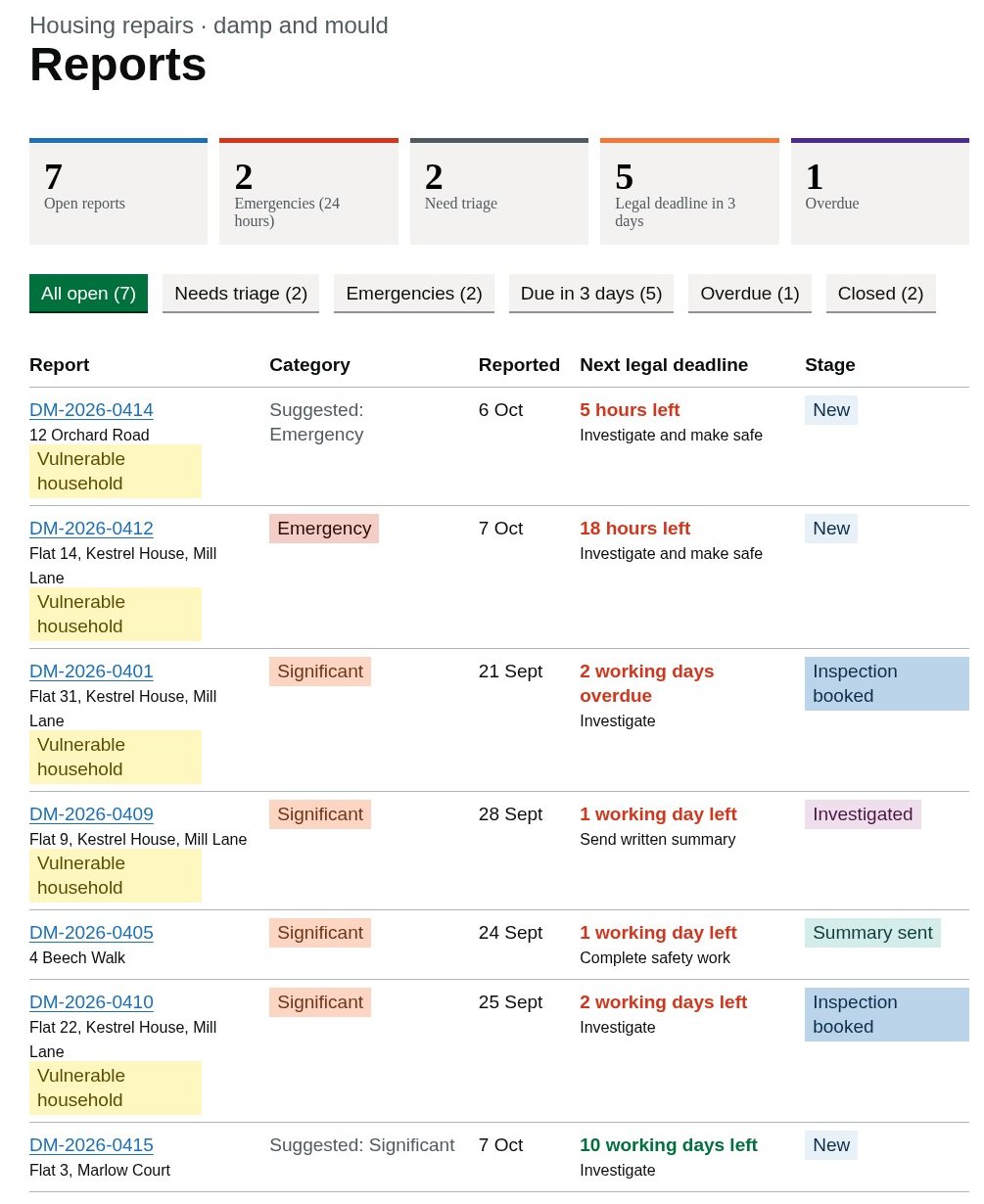
Fixed legal deadlines, still run from phone calls and spreadsheets
Awaab's Law came into force for social landlords in England on 27 October 2025. It is named after Awaab Ishak, a two-year-old who died after long exposure to mould in his family's flat. It puts fixed deadlines on councils and housing associations: emergencies investigated and made safe within 24 hours, other damp and mould investigated within 10 working days, a written summary to the tenant within 3 working days of that, and the home made safe within 5.
In many councils a report still starts as a phone call typed into a repairs system as a general job. Nobody records who lives there, the surveyor turns up without photos, deadlines sit in a spreadsheet, and the same building generates report after report without anyone joining the dots.
So the brief: one service from the tenant's report to the home being safe, where the law's clocks run on their own and people make the judgement calls.
Six calls that shaped the product
The clock starts at the report
The law counts from when the landlord becomes aware, not when someone gets round to triage. So every clock starts the moment a tenant presses send, and the queue is sorted by the nearest legal deadline across every stage.
Ask who lives there
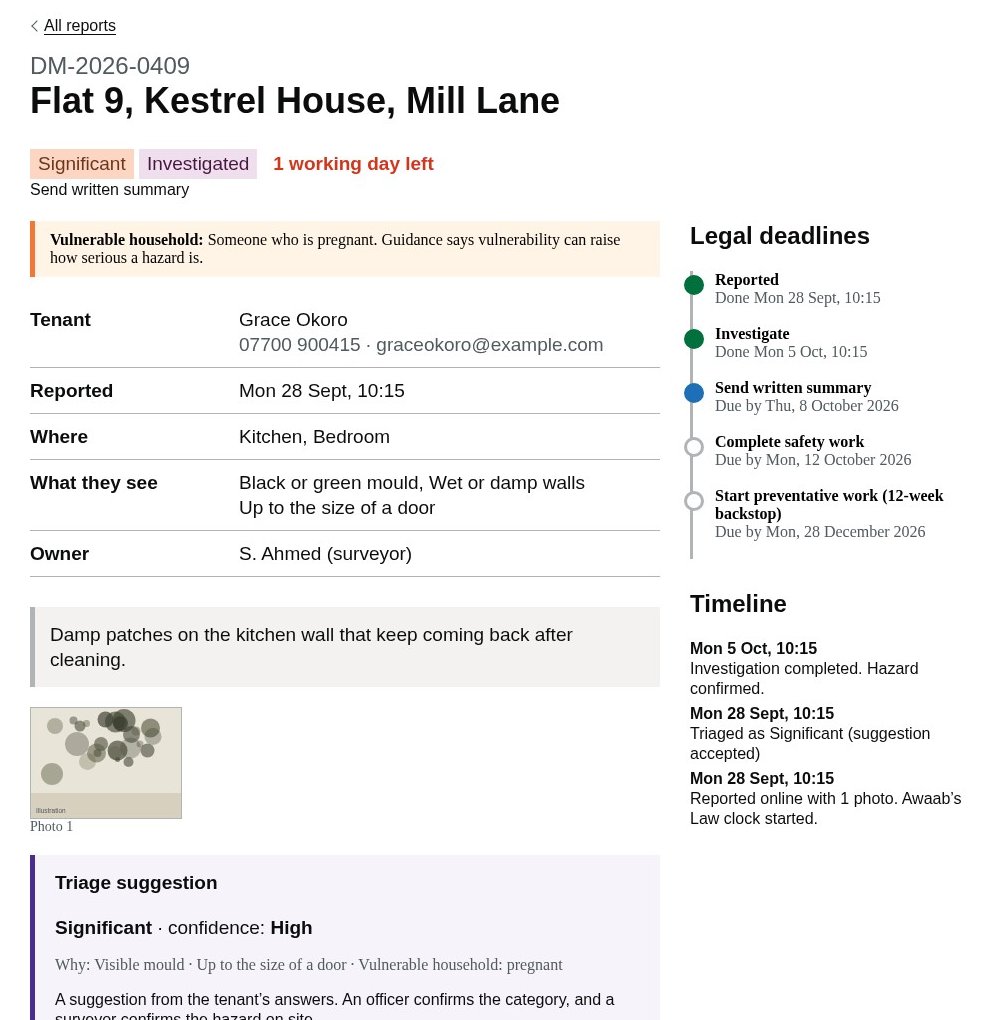
The report asks about babies, pregnancy, breathing conditions and age, because the guidance says vulnerability can make a hazard more serious. Widespread mould with a vulnerable person, water near electrics or a sagging ceiling are suggested as emergencies.
Suggest, then a person decides
The service suggests a category with its reasons. An officer confirms it and a surveyor confirms the hazard on site. The timeline records whether the suggestion was accepted, so the rules can be tuned against real decisions.
Not the tenant's fault by default
If a surveyor puts the cause down to household activity alone, the service stops them with the guidance: find the cause first, and check ventilation, heating and the building before blaming how a family lives.
Evidence for the hard cases
Failed visits are logged with what was tried, which is the evidence a landlord needs for a reasonable endeavours defence. If safety work won't finish in time, offering alternative accommodation is one click and goes on the record.
Fix buildings, not flats
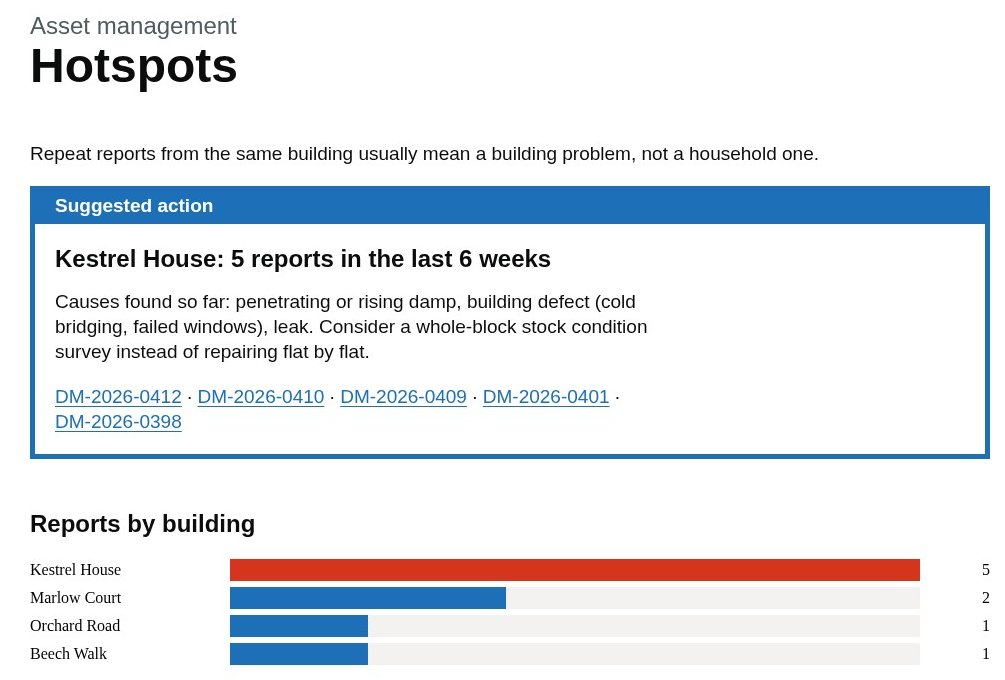
A hotspot view counts reports by building. Five reports from Kestrel House in six weeks, with causes like failed insulation and cold bridging, points to a whole-block survey instead of repairing flat by flat.
Every deadline on one screen
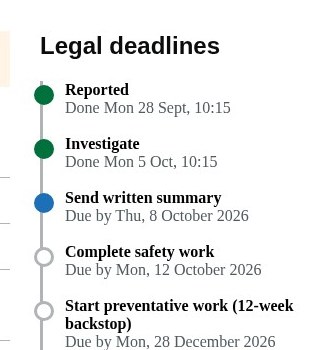
Each case shows the household, the tenant's photos and description, the triage suggestion and the surveyor's findings. Down the side, every legal deadline for that case is laid out with what's done and what's next.
When the surveyor records findings, the written summary letter is drafted from them, so the 3-day duty is a review and a send, not a blank page.
One service for tenants, officers and surveyors
| Screen | What it answers |
|---|---|
| Report a problem | Where is it, what does it look like, who lives here and when can we visit? Photos included, with dates given straight away. |
| Housing team queue | Which home is closest to a legal breach right now? |
| Case | What did the surveyor find, what do we tell the tenant, and is the home safe? |
| Hotspots | Which buildings keep coming back, and why? |
| Compliance | Are we meeting each Awaab's Law deadline? |
Homes made safe on time
This is a concept on synthetic cases, so these are targets, not results.
- Compliance: share of emergencies made safe in 24 hours and significant hazards investigated in 10 working days.
- Repeat reports: the same home reporting again within 6 months, which shows whether the cause was fixed.
- Guardrail: Housing Ombudsman complaints and findings about damp and mould going down, not just speed going up.
Built with an AI agent, judged by me
I built this with an AI coding agent. I made the product calls: when the clocks start, what counts as a possible emergency, what only a surveyor can decide, and where the service should push back on blaming tenants. I based the deadlines on the published Awaab's Law guidance for social landlords.
It's a concept: Westmere Borough Council, the tenants, the buildings and every case are made up, and no texts or letters are sent.
From concept to pilot
- Connect to the council's repairs and housing management systems so jobs and tenancy details flow both ways.
- Texts and letters through GOV.UK Notify, with appointment booking for tenants.
- Phase 2 of Awaab's Law adds more hazards from 30 November 2026. The same clocks extend to them.
- Pilot with one housing area for a quarter, measured against last year's response times.
"When the law sets the deadline, the product's job is to make missing it hard, and to make sure the family is never the first thing blamed."
Got a product, a hard problem, or just want to say hi? Send it over. I read every message.
George Odiana
Open to product roles, side-project collaborations and good conversations about hard product problems.
⚡ 1