Live demo · synthetic cases
A council's Freedom of Information requests, taken off spreadsheets and answered on time.
Open the caseworker view Make a request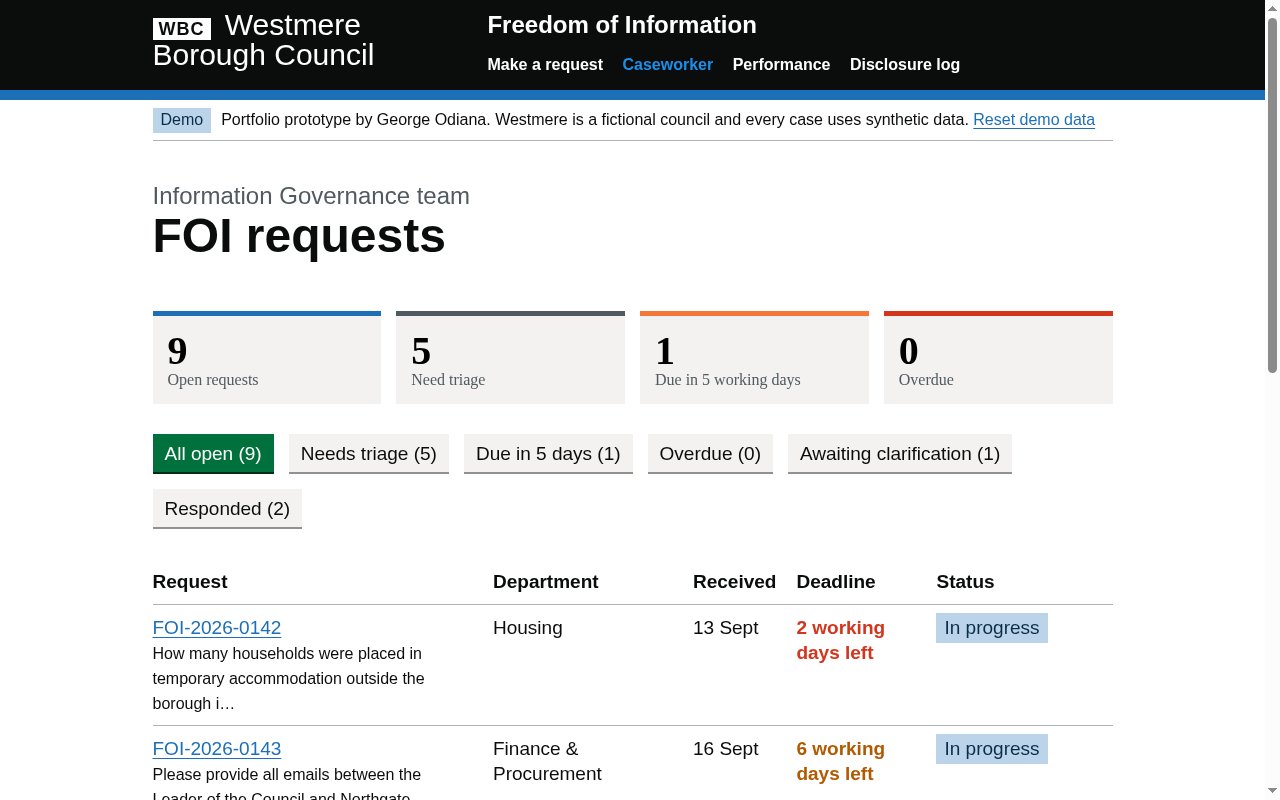
A legal deadline, run from an inbox and a spreadsheet
Anyone can ask a public body for the information it holds, and under the Freedom of Information Act the body has 20 working days to answer. In many councils the process is still manual: requests land in a shared inbox, someone types them into a spreadsheet, counts the deadline by hand and forwards each one to a department by email.
That is where it slips. Bank holidays get missed in the count, the clock isn't paused properly when a requester is asked to clarify, departments get chased by email, and questions that were answered last month get researched again from scratch.
So the brief: one service from request to response, where the system does the counting and routing and officers make every decision.
Six calls that shaped the product
Built like a real GOV.UK service
I used the GOV.UK Design System, the same patterns government and NHS services use: start page, one question per page, check your answers, confirmation panel. Public users already know how it works, and a council team could adopt it without a redesign.
The clock is the product
The deadline is counted in working days, skipping weekends and bank holidays, and it pauses while the council waits for a requester to clarify. Every queue is sorted by time left, so the next request at risk is always at the top.
Suggest, never decide
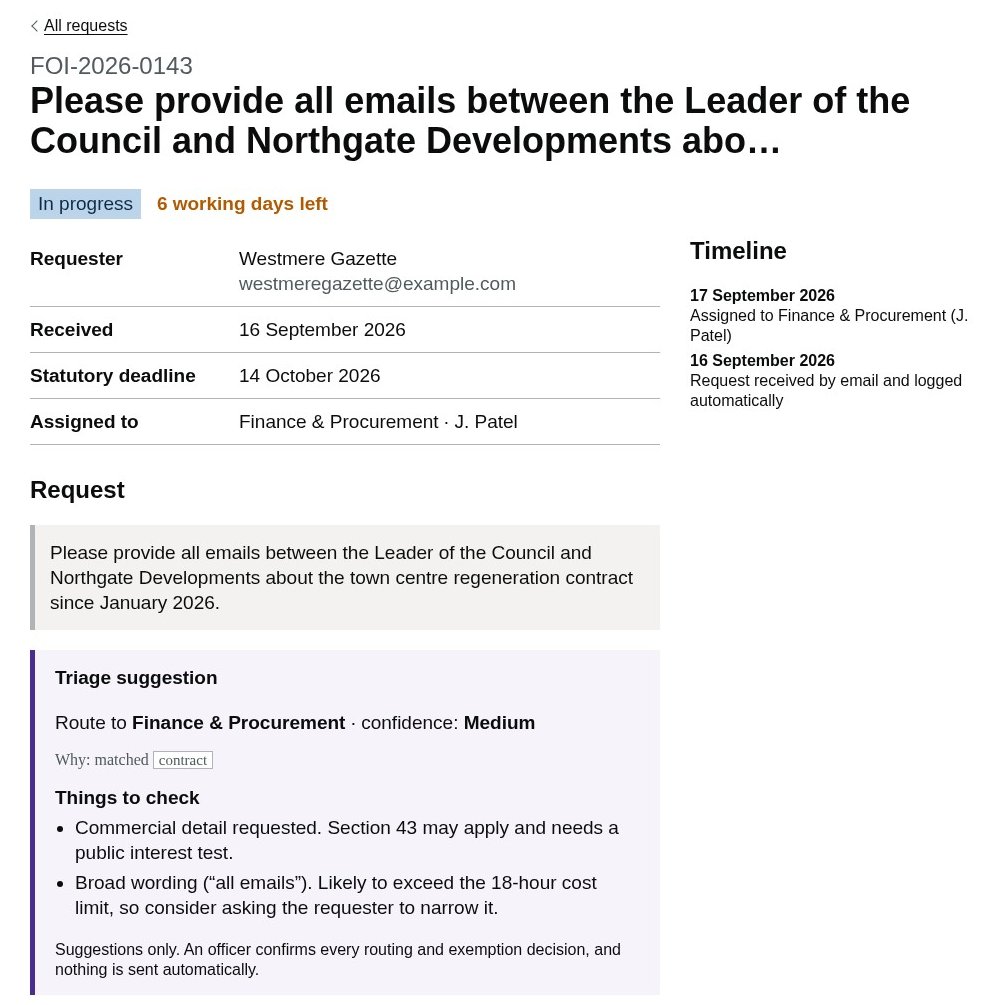
The service suggests a department and shows why (the words it matched) along with a confidence level. Officers confirm or change it, and the timeline records whether they accepted the suggestion. Nothing is routed or sent automatically.
Flag the exemptions early
Broad asks like "all emails" are flagged against the 18-hour cost limit, commercial detail against section 43, and names against section 40, so the officer can ask the requester to narrow it on day 2 instead of day 19.
Not every request is FOI
If someone asks for their own records, the service tells them on the check answers page that this is a subject access request, and flags it for the officer. Getting the route right early saves a wasted 20 days.
Deflect the repeats
At intake the service looks for similar answers already in the disclosure log and shows them to the requester and the officer, which cuts repeat work and supports a section 21 response.
Everything an officer needs, on one screen
Each case shows the request, the statutory deadline, who owns it and a full timeline. The triage panel sits next to the request with the suggested department, the reason, and the things to check before anything is released.
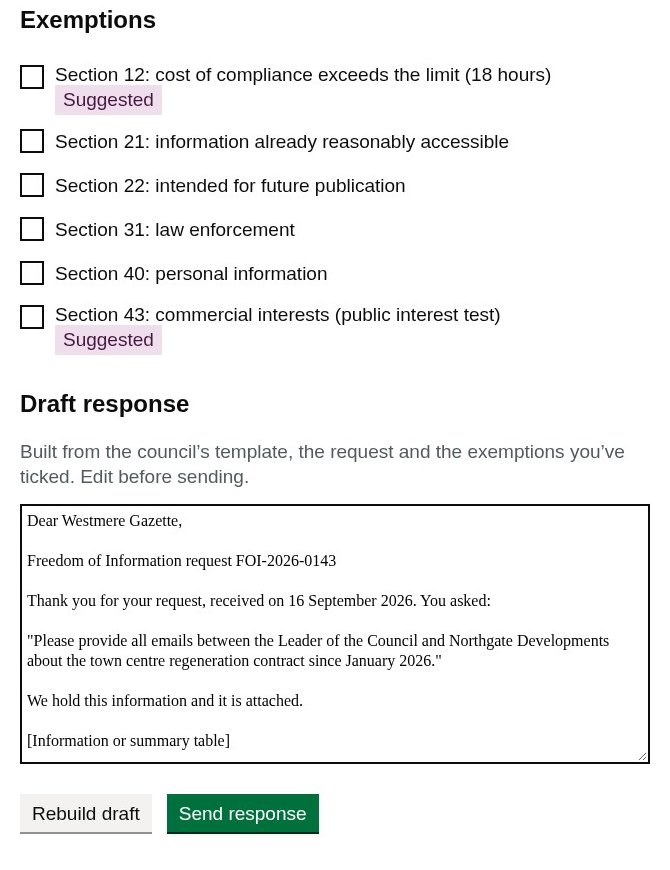
Exemptions are a checklist with the suggested ones tagged. Ticking one rebuilds the draft response from the council's template, including the internal review and ICO wording, ready for the officer to edit and send.
One service for the public and the team
| Screen | What it answers |
|---|---|
| Make a request | How do I ask, and when will I hear back? Gives a reference number and the due date straight away. |
| Caseworker queue | What is at risk right now? Filters for triage, due in 5 days, overdue and awaiting clarification. |
| Case | Who owns this, what might be exempt, and what do we send? |
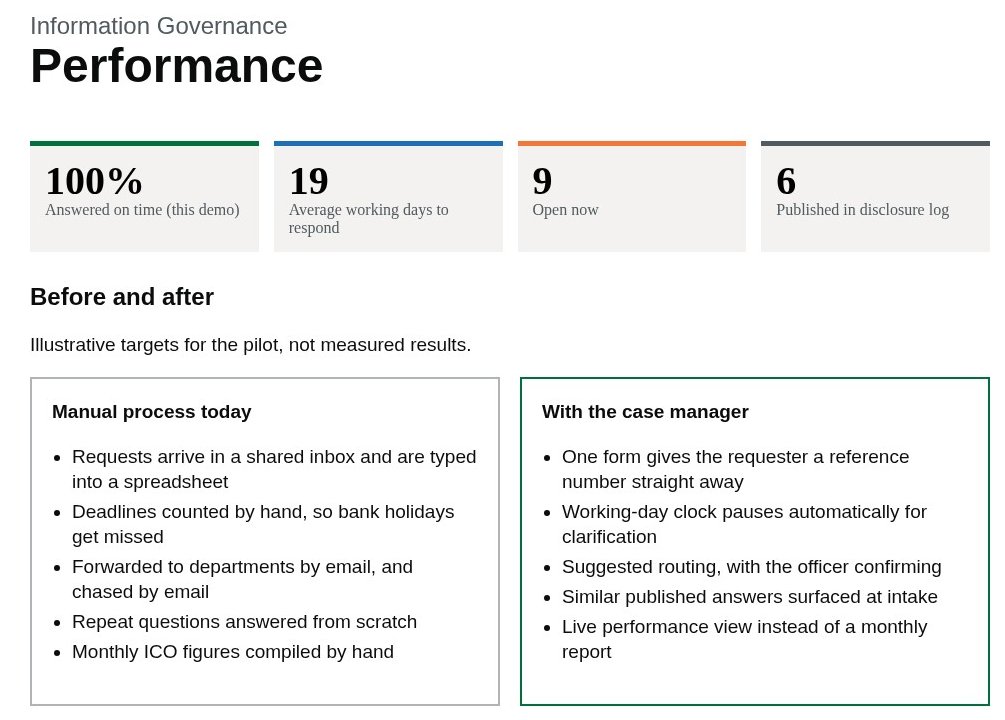
| Performance | Are we answering on time, and where do requests come from? |
| Disclosure log | Has this already been answered and published? |
On time first, then less effort
This is a concept on synthetic cases, so these are targets, not results.
- Compliance: share of requests answered within 20 working days, the number the ICO monitors.
- Effort: officer hours per request, and how many requests are answered from the disclosure log.
- Trust: how often officers accept the suggested route, and internal reviews that overturn a decision as the guardrail.
Built with an AI agent, judged by me
I built this with an AI coding agent. I made the product calls: what the clock counts, what the service may suggest and what only an officer can decide, and which risks to flag at intake. Triage is rules-based on purpose, so every suggestion can be explained.
It's a concept: Westmere Borough Council, the requesters and every case are made up, and no email is sent.
From concept to pilot
- Pull requests in from the FOI mailbox and send replies through GOV.UK Notify.
- Department sign-off inside the case, so nobody chases by email.
- Test an AI triage model against the rules, with an eval suite like the one in Delta, before it replaces them.
- Pilot with one information governance team for a quarter, measured against last year's on-time rate.
"In public services the win isn't automation for its own sake. It's making the deadline impossible to miss while the officer keeps every decision."
Got a product, a hard problem, or just want to say hi? Send it over. I read every message.
George Odiana
Open to product roles, side-project collaborations and good conversations about hard product problems.
⚡ 1