Live MVP · synthetic data
Getting the right referral to the right team, before the 18-week clock runs out.
Try the live MVP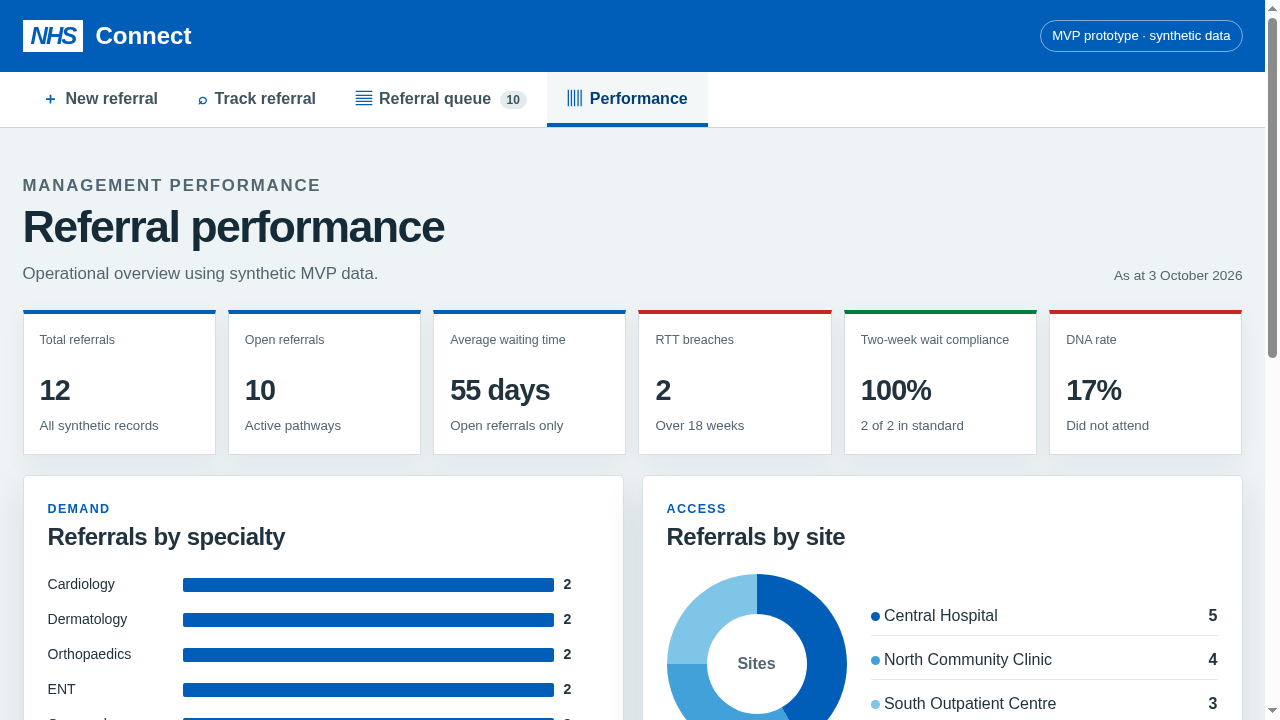
Thousands of referrals a month, five ways in, no single view
The Trust runs outpatient services across several hospital sites and more than a dozen specialties. Referrals arrive by post, fax, email, phone and the NHS e-Referral Service. Letters are often incomplete, staff re-key the same data into several systems, and a suspected cancer referral can sit in a pile like any other.
Patients can't see where they are on the waiting list, so they call the admin team and PALS. Managers find out about 18-week breaches after the fact, from spreadsheets. And patients who don't attend waste clinic slots that someone else has been waiting months for.
The ask: prove in one week, with no real patient data, that a better referral pathway is worth a Trust-wide investment.
Six calls that shaped the MVP
Rules, not a model
Triage reads the referral text for predefined indicators and recommends a priority and team. Every result can be traced to the rule that fired, which a clinical safety officer can actually review.
Decision support only
The tool never diagnoses. It says so on screen, and every recommendation goes to a clinician. Even the referrer's own priority is marked "subject to clinical review".
Synthetic by design
A banner on every screen, a confirmation box on the form and test-only reference numbers make it hard to put real patient data in by accident.
One record, three views
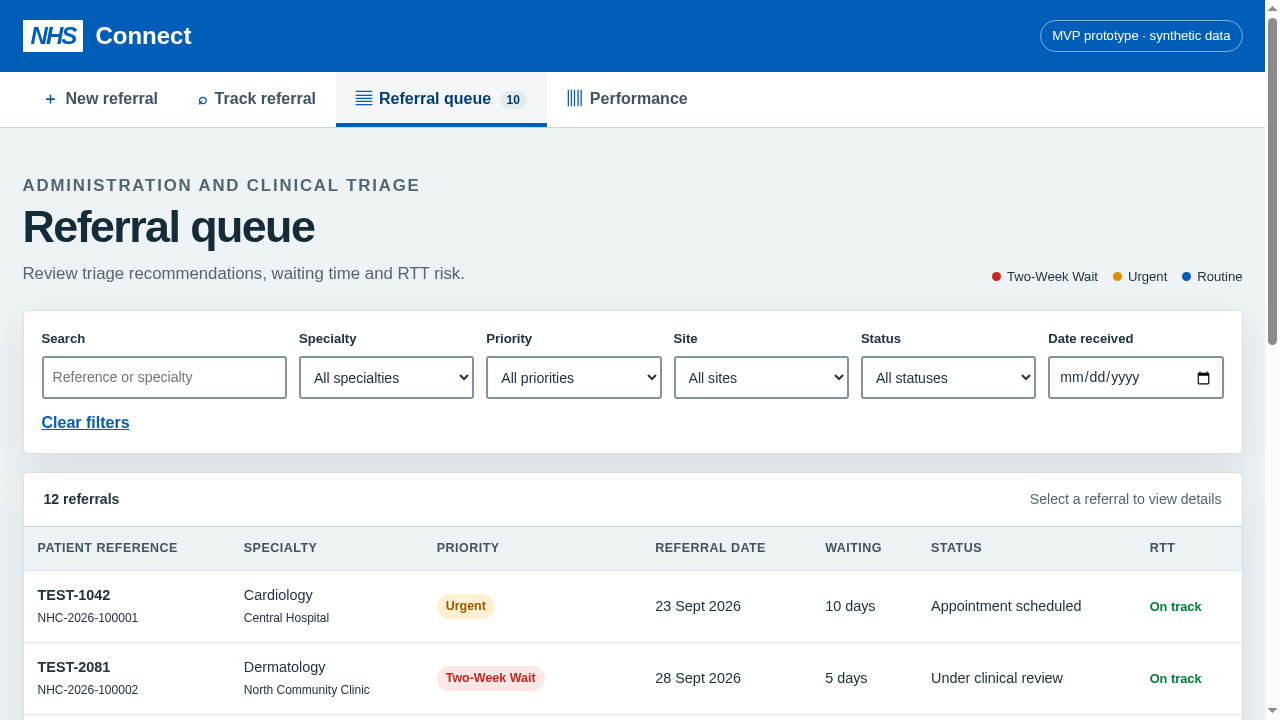
The patient or GP submits, staff work the queue, managers see performance. Everyone looks at the same referral, so nothing gets re-keyed.
Structure at the front door
Required fields for specialty, reason, priority, site and contact preference fix the incomplete-letter problem before triage even starts.
Waiting time is the headline
18-week RTT breaches and two-week-wait compliance sit at the top of the dashboard, because those are the numbers a Trust board is held to.
Four priorities, each with a named destination
| Priority | When | Goes to |
|---|---|---|
| Two-week wait | Suspected cancer indicators | Suspected Cancer Pathway |
| Urgent | Severe or rapidly worsening | Rapid Access Clinical Team |
| Routine | Stable and non-urgent | Specialty Outpatient Team |
| Planned | Follow-up and surveillance | Routine review |
The rules lean cautious on purpose. A routine case pushed up for a clinician to check costs a few minutes. A two-week-wait case left in the routine pile can cost far more.
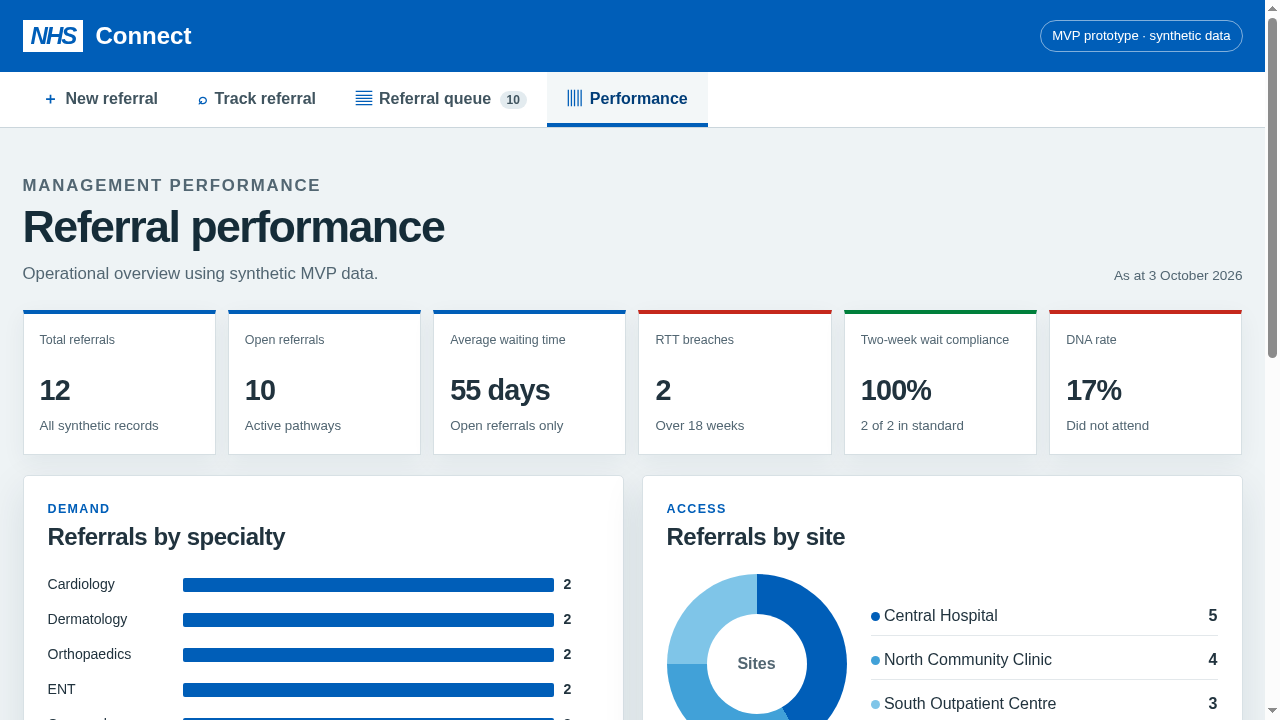
What a manager sees on a Monday morning
Figures from the MVP's synthetic dataset:
Under the headline numbers it breaks referrals down by specialty and by site, which is where bottlenecks show up first.
A working product in five days
We ran it as a cross-functional team: project managers, scrum masters, PMO analysts and business analysts, with everyone taking part in the build. The work behind the screens was the usual delivery kit: as-is and to-be process maps, a backlog of user stories with acceptance criteria, KPI definitions and a RAID log.
As Digital Product and Delivery Manager I sat across what we built and how we delivered it: prioritising the backlog against the one question the Trust cared about, coordinating the team through the week, and leading the final presentation and live demo. Anything that didn't help answer that question got cut.
The MVP was built with AI-assisted development. That made it possible to put a clickable product in front of stakeholders within the week, so the conversation was about the pathway rather than about slides.
Before it goes near a real patient
- Clinical sign-off on every triage rule, and a test set of referrals the rules must classify correctly before any change ships.
- A clinical safety case under the NHS standards for health IT (DCB0129 and DCB0160).
- Integration with the e-Referral Service and the Trust's patient administration system, so intake replaces re-keying rather than adding to it.
- Appointment reminders and DNA risk flags, measured against the 17% DNA rate in the baseline.
"In healthcare, a triage rule you can't explain is a rule you can't ship. The boring, readable version is the one that gets through governance."
Got a product, a hard problem, or just want to say hi? Send it over. I read every message.
George Odiana
Open to product roles, side-project collaborations and good conversations about hard product problems.
⚡ 1